The Rotary Phone on My Desk: A Poet’s Relationship With Time
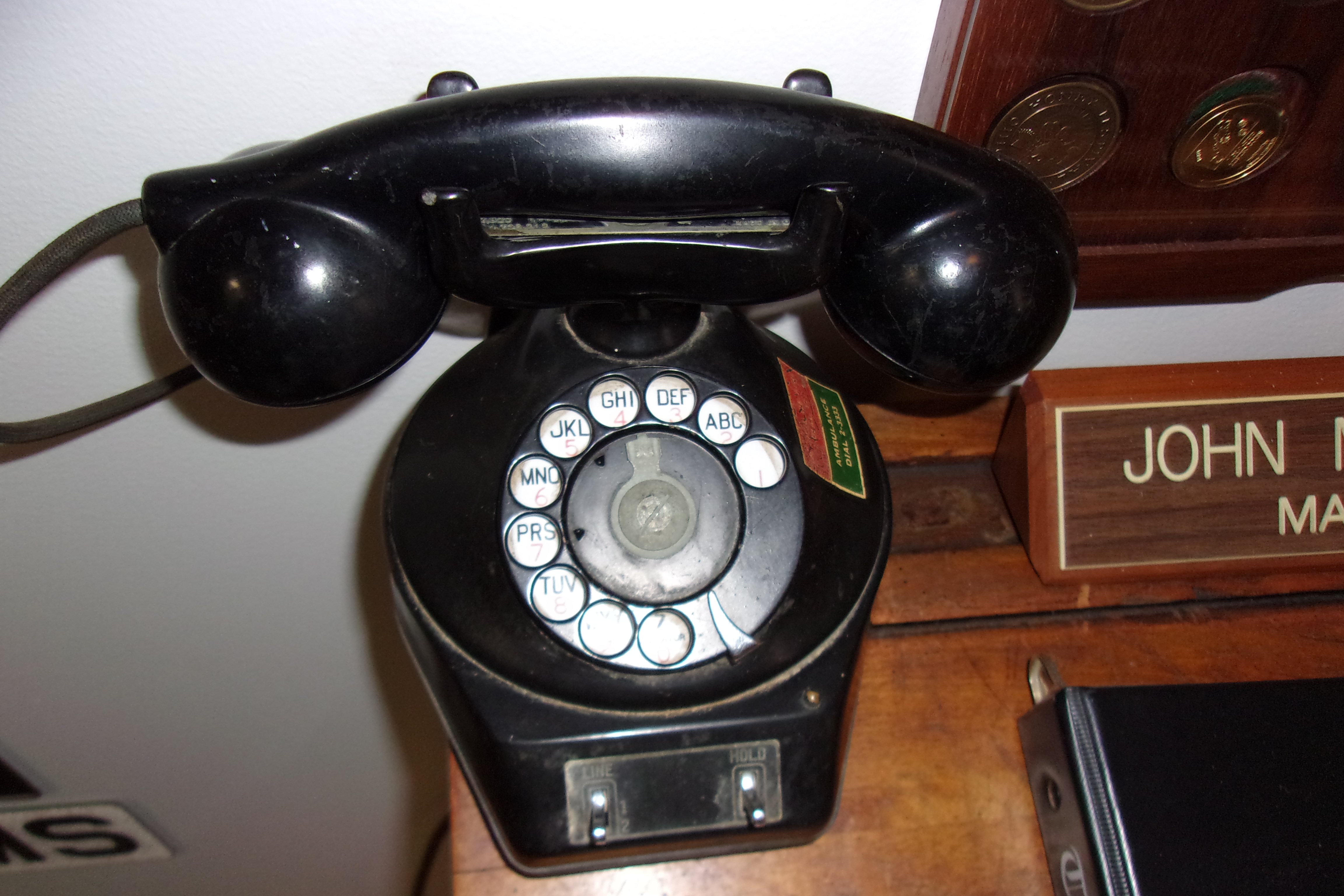
On the corner of my desk, sits a rotary phone the color of an old storm cloud. Its coiled cord rests like a sleeping wire, its receiver curved in a permanent half-listen. The hard plastic is scuffed in places where other hands, other years, have worn their stories into it.
In the quiet between each of my handwritten words, I catch myself looking at it the way you look at an elder in the room – with a soft respect, a little curiosity, the sense that if you sit long enough, it might tell you what you’ve been meaning to hear. It doesn’t ring anymore. It’s a relic, not an instrument now. But it still feels charged with something like possibility. It still dials and whirls back. Nice sound.
A rotary phone demands patience. You don’t tap at it; you commit to it. Your finger slips into a numbered groove, you pull the dial around in a slow arc, listening to the whirring return, that small mechanical sigh as it spins home. One number. Then another. Then another. You can’t rush a circle. Try, and it will snap your impatience right back at you.
There’s a kind of courage in dialing that way. Each number is a tiny decision you have to stand inside of. No backspace. No delete. If you misdial, you don’t get an error message; you get a stranger, or a dead line, or a sudden, humbling silence. You have to hang up, start over, retrace the circle with a little more care.
That’s what the phone has come to mean for me as an author and a poet: the slow, deliberate act of connection. I can’t text a poem into existence. I can’t swipe my way to a sentence that feels true. I have to dial it — letter by letter, line by line — trusting that if I move slowly enough, the right voice will answer on the other end.
I can’t text a poem into existence. I have to dial it — letter by letter, line by line — trusting that if I move slowly enough, the right voice will answer.
— John Michael
Writing, for me, has always felt more like calling than like composing. I listen longer than I speak. I circle the idea a few times before I dare to touch it. The poem isn’t a message I manufacture; it’s a conversation I’m trying to reach. The rotary dial reminds me that every word is a number, every line a patient revolution of the wrist toward something waiting in the dark. I still write every poem and every piece of prose long handed. I can feel my words that way.
I remember the first phone that ever felt like an altar. It was in my grandmother’s kitchen, bolted to the wall, beige and humming slightly, like it contained a small hive of bees. The cord was long enough to stretch around the corner into the hallway, where secrets were better kept. I watched her dial with a kind of reverence, her finger steady, unhurried, as if she knew time would meet her halfway. Of course, there were “party lines” back then. You shared the phone with five or ten neighbors. Sometimes you had to wait to call someone. When impatient, you had to ask your neighbor to please hang up so you could make an urgent call.
One summer, I borrowed that hallway for myself. I was a teenager then, newly infatuated with a girl who lived just far enough away that every call felt like crossing a border. I’d pull the cord tight, sit on the floor with my back against the cool wall, and spin out her number, one slow circle at a time. I still remember the sound of her hello blooming through that receiver — tinny, imperfect, miraculous. The first night we talked three hours! I asked her to go steady with me. Without a kiss, yet! Go figure. Innocent times. Innocent minds. They are still in me that way.
Years later, that memory became a poem. Not because it was a love story that lasted, but because it was my first experience of intentional waiting. The ring between each dial tone. The ache of hearing the line ring and ring, wondering if she’d answer, or if the universe had other ideas. The poem wasn’t about romance, really. It was about listening into absence and finding it full of its own language.
Now, I live in a world where conversations live inside glowing rectangles, where I can send a dozen messages before I’ve even finished my morning coffee. As a performer, I can go live, post, stream, broadcast myself in real time to people I’ve never met. There is a thrill in that, a strange electricity in feeling so reachable. But it also asks me a dangerous question: why wait, when you could say something now?
The old phone on my desk is my quiet rebellion. It insists that some things are worth not saying right away. That the pause before the line picks up is part of the conversation. That a poem needs stillness the way a call needs a dial tone. I write slowly, on purpose. I let the first thought pass, then the second, and wait to see what’s left when the noise has settled.
Onstage, when I’m reading or performing, I try to bring that same rotary patience. The poem has already taken its long road to get there — drafts crumpled, lines redialed, endings hung up and started over. So when I stand in front of a room, I want to honor the time it took. I breathe between lines. I let silence have its say. I imagine each listener as a single number I’m dialing, carefully, hoping to reach something tender and alive in them.
Being an author in this digital century feels, some days, like being a rotary phone in a world of touchscreens. Clunky. Outdated. A little absurd. But there’s also a strange freedom in that. I don’t have to keep up with every scroll and ping. I can choose slowness as a form of devotion — to language, to attention, to the fragile, beautiful act of one human trying to make sense to another.
If you and I ever meet at a reading, or you pick up one of my books, I hope it feels less like content and more like a call. Not a notification, but a number you dial when you’re ready to sit with something a little longer. When you’re willing to listen to the clicks and whirs inside yourself, the old machinery of feeling that doesn’t move at the speed of Wi‑Fi.
So here’s your invitation, from my desk with its patient rotary: come connect. Come to a performance and let the words ring in the air between us. Find a book and give it the luxury of an unhurried afternoon. Or simply put your phone face down, breathe, and notice one true sentence forming inside you, number by number, circle by circle.
When you’re ready, I’ll be here — an author, a poet, a performer dialing your silence with mine — trusting that on the other end of this long, slow line, someone like you is waiting to say hello.


Leave a comment